
n8n, Make and Zapier all connect apps and run AI steps, but they count usage differently. Zapier bills per action step, Make per module run, and n8n per whole workflow run. That makes Zapier the easiest start, Make the cheapest entry, and n8n the better fit for long workflows, AI agents and self-hosting.
Plan prices, limits and licence terms below were read on each vendor’s own site on 7 October 2026. All three change their plans often, so recheck before you commit. We build n8n and Make workflows with AI steps, mostly on self-hosted n8n, so we lean towards n8n. We’ll say where Zapier or Make is the better buy.
n8n vs Make vs Zapier at a glance (October 2026)
| n8n | Make | Zapier | |
|---|---|---|---|
| Billing unit | Execution: one run of a whole workflow, any number of steps | Credit: one module run; some AI features use more | Task: one successful action step; triggers and built-in tools such as Filter, Paths and Formatter are free |
| Free option | Self-hosted Community Edition; cloud has a trial with 1,000 executions | 1,000 credits a month, 2 active scenarios, 15-minute minimum interval | 100 tasks a month, two-step Zaps |
| Entry paid plan | Starter: €20 a month billed annually (€24 monthly), 2,500 executions | Core: $9 a month billed annually ($10.59 monthly), 10,000 credits | Professional: $19.99 a month billed yearly ($29.99 monthly), 750 tasks |
| Next step up | Pro: €50 (€60 monthly), 10,000 executions | Pro: $16; Teams: $29, both at 10,000 credits | Team: $69 a month billed yearly, 2,000 tasks, 25 users |
| Self-hosting | Yes. Community Edition is free; Business (€667 a month, 40,000 executions) is self-hosted only | No. Cloud on AWS, EU or North America | No |
| Integrations, vendor’s count | 2,307 in the directory on the day we checked, plus an HTTP node for any API | 3,000+ apps | 9,000+ apps |
| Users | Unlimited on every plan | Unlimited on every plan | Shared work starts on Team |
| AI agents | AI Agent node | Make AI Agents, in beta, on every plan | AI steps in Zaps; Agents as an add-on |
| MCP | MCP Server Trigger and MCP Client | MCP server on every plan | Zapier MCP on every account; one tool call uses two tasks |
Two cautions about this table. App counts are the vendors’ own and aren’t counted the same way. And the entry prices buy different amounts of work, which is what the next section is about.

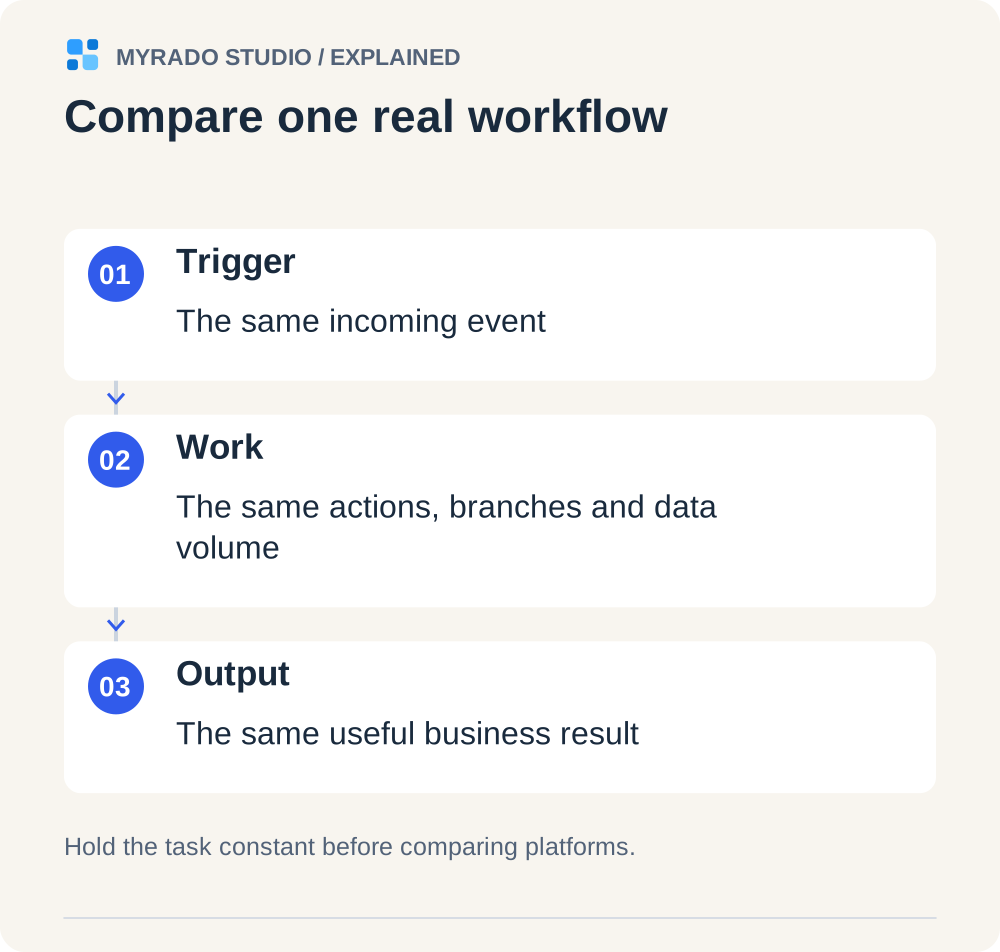
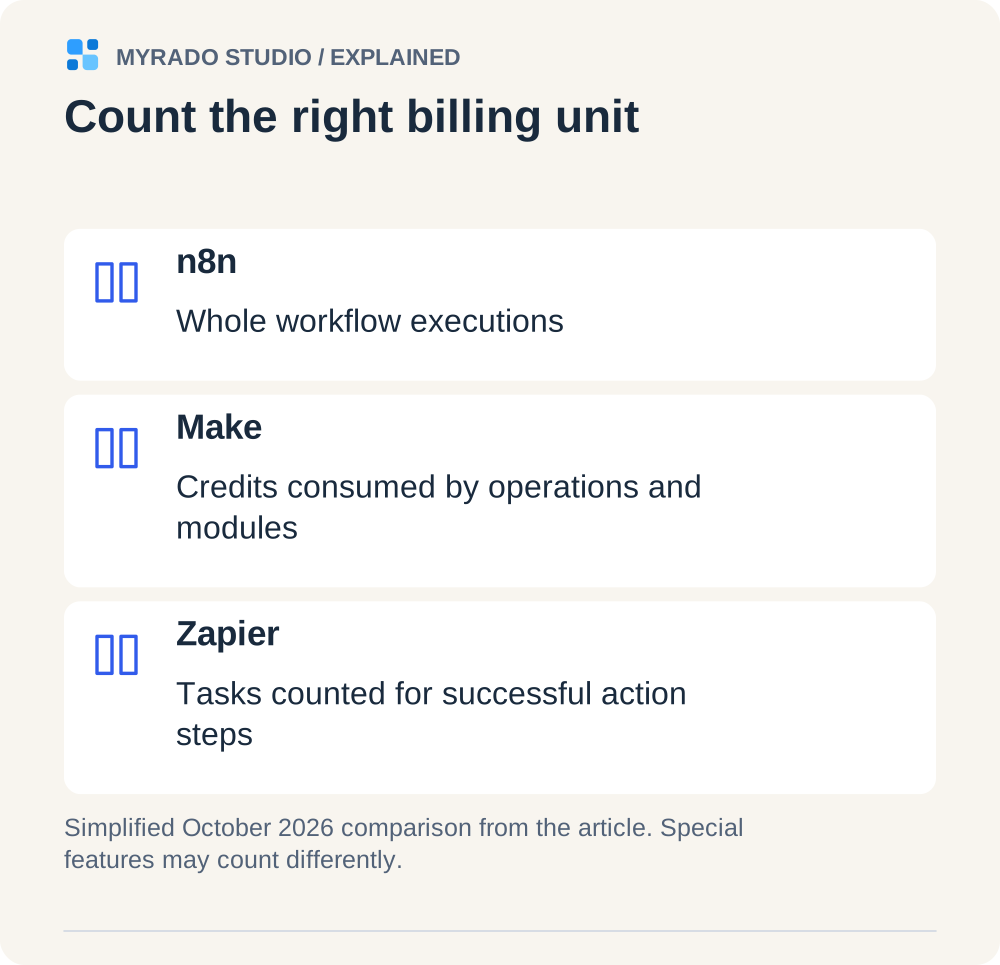
How each platform counts usage, with one workflow priced on all three
The three billing units
- n8n: executions. One run of the whole workflow is one execution, whether it has three steps or thirty. The pricing page says this in so many words.
- Make: credits. Make’s help center states that for ordinary apps one operation equals one credit, and an operation is one module run for one item. Ten new rows passing through three modules are thirty credits, plus one for the trigger.
- Zapier: tasks. A standard action step is one task. The trigger, polling for new data and Zapier’s built-in tools use none. AI steps, code and MCP calls draw from the same task pool, at different rates.

A five-step lead workflow
This is an illustrative workflow, not a client case: a webhook receives a website form, a step enriches the company, an AI step classifies the request, a step creates the CRM deal and the last one posts to Slack. That is one trigger and four actions. The AI step runs on your own model key.
| n8n Cloud | Make | Zapier | |
|---|---|---|---|
| Counted per run | 1 execution | 5 credits | 4 tasks |
| 1,500 runs a month | 1,500 executions | 7,500 credits | 6,000 tasks |
| Plan that fits | Starter, 2,500 executions | Core, 10,000 credits | Professional, 10,000 tasks |
| Price, annual billing | €20 a month | $9 a month | $129 a month |
| Price, monthly billing | €24 | $10.59 | $193.50 |
| 5,000 runs a month | 5,000 executions | 25,000 credits | 20,000 tasks |
| Plan that fits | Pro, 10,000 executions | Core, 40,000 credits | Professional, 20,000 tasks |
| Price, annual billing | €50 a month | $29 a month | $189 a month |
At this length and volume Make is cheapest, n8n Cloud is close, and Zapier costs several times more. Model usage is paid to the model provider in all three columns.
The opposite case: two steps, 30,000 runs
Now take a webhook that writes one row to a database, 30,000 times a month.
- Make: 60,000 credits. The 80,000-credit Core tier was $55 a month on annual billing, $64.71 monthly.
- Zapier: 30,000 tasks. The 50,000-task Professional tier was $289 a month on annual billing.
- n8n Cloud: 30,000 executions. The pricing page showed Pro at 10,000 and Business at 40,000 executions (€667 a month, self-hosted only), so this volume needs a larger plan size or a quote.
- n8n Community Edition on your own server: no usage fee at any volume.
Per-run pricing rewards long workflows. Per-step pricing rewards short ones. Self-hosting removes the meter and replaces it with a server and upkeep.
What multiplies the count
- Make: polling triggers. A trigger that checks for new data uses one credit per check, even when nothing is new. Every 15 minutes is 2,880 checks in a 30-day month; every minute is 43,200. Use instant (webhook) triggers where the app offers them.
- Make: many items. Each item a trigger returns runs through every later module separately.
- Zapier: AI steps. An AI step costs 1 task on a standard model or your own model, 3 on an advanced model and 5 on a premium one, and each tool call the model makes is billed again at the same rate. A Zapier MCP tool call is 2 tasks.
- n8n: schedules. Every scheduled run counts. n8n’s own FAQ puts a five-minute schedule at about 8,600–8,900 executions a month.
AI agents on n8n, Make and Zapier
| n8n | Make | Zapier | |
|---|---|---|---|
| Building block | AI Agent node: you connect a chat model and at least one tool, and the agent decides which tools to call | Make AI Agents (beta), built and managed inside Make | AI by Zapier steps inside Zaps; Zapier Agents as a separate add-on |
| How agent work is metered | The whole run is one execution | Credits per operation; on Make’s AI Provider, tokens are converted to credits as well | Tasks per AI step and per tool call; the Agents add-on counts “activities”: 400 a month free, 1,500 for $33.33 a month billed annually |
| Your own model key | Yes | Yes, on paid plans; then you pay Make per operation and the provider per token | Yes; 1 task per step and per tool call |
| MCP | Can call MCP servers and expose workflows as MCP tools | Exposes scenarios through its MCP server | Exposes app actions through Zapier MCP |
Take an illustrative agent that makes eight tool calls to answer one request. On n8n that is one execution. On Zapier, by the published rates, it is at least 9 tasks with your own model, 27 on an advanced model and 45 on a premium one. On Make it is at least eight operations plus tokens. On Make’s AI Provider one credit buys 3,616 input tokens or 452 output tokens of GPT-5 mini, and 904 input or 181 output tokens of Claude Haiku 4.5.
Price is one side. The other is control:
- n8n lists human approval for tool calls, evaluations and error workflows among its features, and lets you add code where a node falls short. You need someone technical to set it up well.
- Zapier gives an agent the widest set of ready actions. If the goal is “let Claude or ChatGPT create a task in the tool we already use,” Zapier MCP may be the shortest path.
- Make is the most visual of the three. Its AI agents were still labelled beta in October 2026, so test before relying on them for customer-facing work.
Any of the three can also expose your automations to an AI assistant over MCP. When you need per-user permissions and an audit log on your own systems, a custom MCP server is the next step.
Self-hosting and licence: what “free” means for n8n
n8n’s Community Edition is free to run on your own server. Three things to know before you count on it.

The licence is fair-code, not open source. n8n’s licence page explains the Sustainable Use License: you may use and modify n8n for your own internal business purposes, and you may sell consulting and build workflows for clients. You may not host n8n and charge others for access, or white-label it, without a commercial agreement. For a business automating its own processes, this changes nothing. For an agency planning to host many clients in one instance, it does.
Some features are paid even when self-hosted. Single sign-on, Git-based version control and multiple environments are listed under the Business plan, which is self-hosted only, costs €667 a month on annual billing and includes 40,000 executions.
The server and the upkeep are yours. A small virtual server is enough for most small-business workloads; as a reference point, DigitalOcean listed basic droplets at $6 a month for 1 GB of memory and $12 for 2 GB in October 2026. The larger cost is attention: updates, backups, monitoring and SSL. Plan for regular maintenance time, or pay someone to do it.
In return, workflows, run logs and credentials stay on your infrastructure, and data leaves it only when a step calls an outside service such as an AI model or your CRM. Make and Zapier don’t offer this.
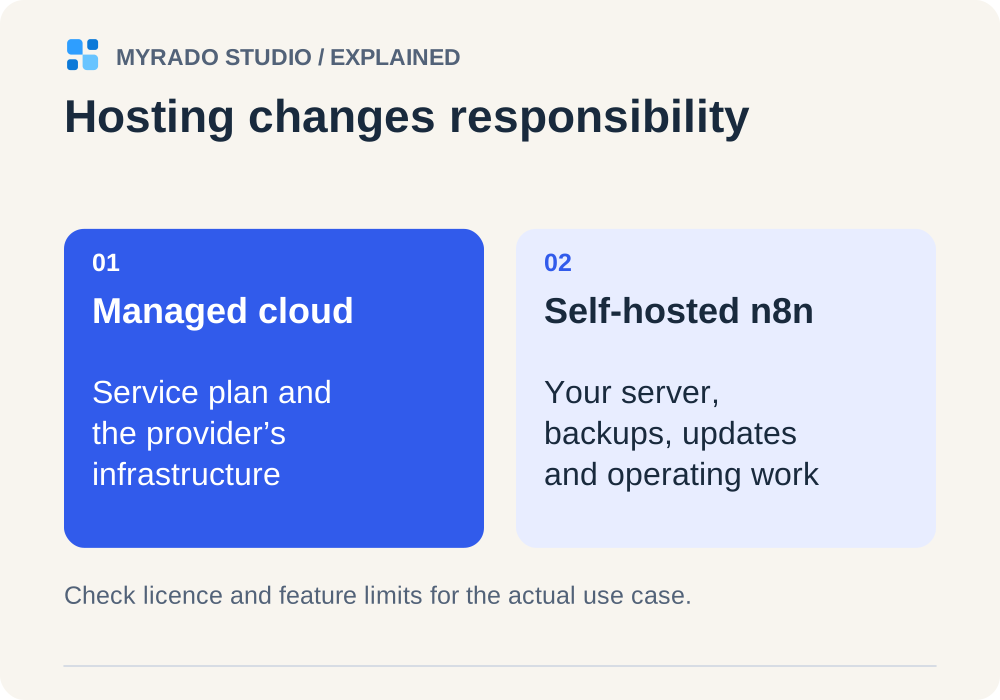
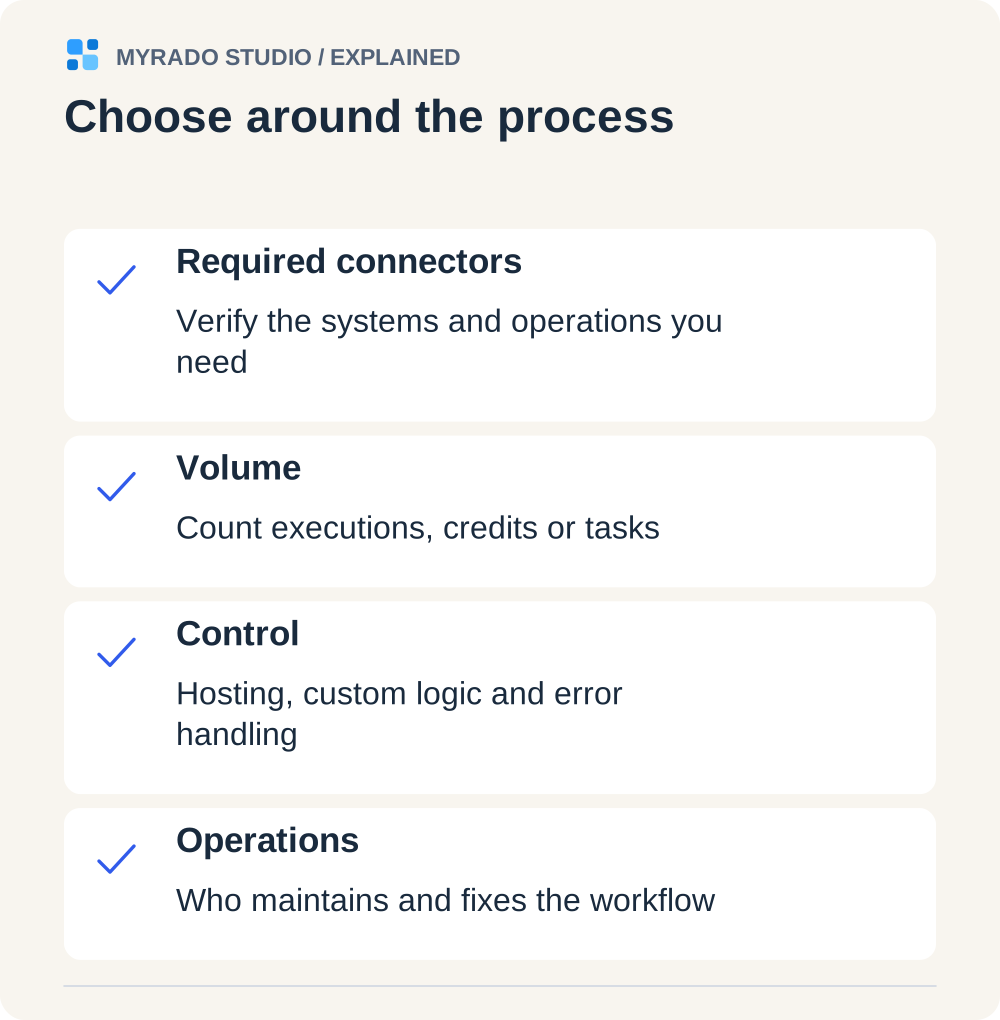
Which one to choose: decision rules
These are our rules of thumb.
Pick Zapier when:
- the people building automations aren’t technical and need results this week;
- you need an app that only Zapier supports;
- volume is low and Zaps are short, so the 750 or 2,000-task tiers are enough.
Pick Make when:
- workflows branch a lot and you want to see the whole flow on one canvas;
- price matters at moderate volume: 10,000 credits for $9 a month is the lowest entry of the three;
- most triggers can be instant, so polling doesn’t eat the credits.
Pick n8n when:
- workflows are long, loop over data or include an AI agent with many tool calls;
- data has to stay on your own server, or you want no usage meter at all;
- you have a developer, or a contractor, to own it.
Mix them when it’s cheaper. Nobody has to migrate everything. Keep the short Zaps that work and move the two or three automations that produce most of the task bill.
If the job is really a conversation with a customer and not a background process, a workflow tool is only part of the answer. See AI agent vs chatbot, and for phone calls, AI voice agent cost per minute.
What clients ask for: demand data
- Job posts. In Upwatcher’s analysis of 4,089 AI job posts on Upwork (the 30 days ending 16 May 2026), n8n was the seventh most requested skill with 357 posts, Zapier eighth with 274 and Make tenth with 230.
- Our own sample. Among 183 client requests we read on Upwork, Freelancer.com, PeoplePerHour and Hacker News, mostly from June–September 2026, about 38 named n8n, about 12 named Make and about 6 named Zapier. The counts are approximate. “n8n or Make” was a common phrase, and Zapier appeared mostly as a tool the client already had.
- Prices for the work. Upwork’s hiring guide for n8n experts (September 2026) lists $500–2,000 for a single workflow and $2,000–5,000 for a multi-app one. On Fiverr the median starting price in the first 48 results was $80 for “n8n ai automation” and $30 for “make com ai automation.”
- Repairs. Eight of the 183 posts came from clients whose existing bot or workflow had stopped working.
The last number is the one to remember. A workflow that fails without telling anyone costs more than any plan in the table.
Typical mistakes when choosing
- Comparing plan prices without counting units. $9, €20 and $19.99 buy 10,000 module runs, 2,500 whole runs and 750 action steps.
- Estimating from the happy path. Count retries, error branches and the items that arrive in batches.
- Leaving a polling trigger on a one-minute interval in Make.
- Using the largest AI model for every step. On Zapier that multiplies tasks; everywhere it multiplies token cost. Sorting an email rarely needs a premium model.
- Building on the freelancer’s account. If the workflows and credentials aren’t in your account, leaving means a rebuild.
- Self-hosting with no backups or alerts. Free software doesn’t include an operator.
- Skipping error handling. Whichever tool you pick, a failed run should alert a person and keep its input for a re-run.
How we would approach it
- Map the process first. What triggers it, which tools it touches, how often it runs and what a failure costs. Within 24 hours you get a workflow map, a stack and a fixed quote.
- Count the units on each platform for your real volumes, as in the tables above, before recommending one. If Zapier or a template does the job, we say so.
- Build in your account or on your server, with retries, an error workflow and alerts.
- Hand over the workflow files and a short document for each workflow.
A new n8n or Make workflow starts at $800 and usually goes live in 3–7 days. Fixing an existing workflow starts at $400 and usually takes 48–72 hours. Hosting, platform plans and AI model usage are paid directly on your own accounts, and 30 days of tuning are included. Describe the workflow on the n8n automation page to get a workflow map and a quote.
FAQ
Is n8n better than Zapier?
For long workflows, AI agents, custom code and self-hosting, usually yes: n8n counts one execution per workflow run however many steps it has, and its Community Edition runs on your own server. Zapier is better when you need a quick setup by a non-technical team or an app only Zapier supports. It lists 9,000+ apps and bills per action step.
Is n8n really free?
The self-hosted Community Edition has no licence fee. You pay for a server and for the time to keep it updated and backed up. n8n Cloud is paid: in October 2026 Starter cost €20 a month billed annually for 2,500 executions and Pro €50 for 10,000. The licence is fair-code, not open source: internal business use is free, but you can’t resell n8n as a hosted service.
Which is cheapest: n8n, Make or Zapier?
It depends on workflow length and volume. In our October 2026 example, a five-step lead workflow run 1,500 times a month fits Make Core at $9, n8n Starter at €20 and Zapier Professional at $129 a month on annual billing. For a two-step workflow run 30,000 times, Make came to $55 and Zapier to $289, while self-hosted n8n has no usage fee.
What is the best automation platform for AI agents?
n8n suits agents with many tool calls: one agent run is one execution, you bring your own model key, and it can both call and expose MCP tools. Zapier gives an agent the widest set of ready actions, but AI steps and tool calls are metered in tasks. Make sits between the two, with AI Agents in beta on every plan in October 2026.
Can I self-host Make or Zapier?
No. Both are cloud services. Make’s pricing page lists hosting on AWS in the EU or North America and an on-premises agent on the Enterprise plan for reaching systems inside your network. Of the three, only n8n can run entirely on your own server.
Is n8n open source?
Not by the Open Source Initiative’s definition, and n8n says so itself. The source code is public under the Sustainable Use License, a fair-code licence. You may use and modify it for your own internal business purposes and offer consulting on it. Hosting n8n for paying customers or white-labelling it needs a commercial agreement with n8n.
Can I move my Zaps or Make scenarios to n8n?
Yes, but there is no one-click import. Each Zap or scenario is rebuilt as an n8n workflow, credentials are re-created, and both versions run side by side until the new one matches on real data. It pays off mainly for multi-step, high-volume automations where per-task pricing has become the largest line on the bill.