
In short: the money in vertical AI during 2025–2026 followed one problem — the phone rings, nobody picks up, and a customer worth hundreds or thousands of dollars calls the next business on the list. Companies that package an answering agent for a specific industry have raised large rounds or been acquired, while the horizontal “autonomous sales agent” category has had a rougher time. Below: the evidence for the pain, who is building what, what it costs, and where the technology still needs a human.
Figures come from public company announcements, vendor price pages and trade press, with dates. Where a source is a vendor describing its own results, we say so. If you want to see how this looks in a finished product, see our page on AI voice agents and AI receptionists.
The pain: missed calls and slow replies
Several independent datasets point the same way.

- Unanswered calls. Invoca’s 2026 data puts the share of missed calls at about 44% across roughly 70 million calls. The founders of Toma, which sells to car dealerships, found that US dealerships answer only 45% of the calls they receive.
- Slow first response. In a February 2026 survey, 3% of teams replied to a new lead within five minutes and 31% took more than 24 hours. A 2026 test by RevenueHero found that 63.5% of 1,000 companies did not reply to a test inquiry at all.
- Speed matters. The 2011 Harvard Business Review study of lead response found that contacting a lead within an hour made qualification roughly seven times more likely than waiting a further hour. It is old, but it is still the most-cited number.
- Quality of the conversation. In a sample of 50,000 sales calls analysed by Ringostat in late 2024, AI rated the average manager conversation at 2 out of 5 and 77% at 3 or below. That sample is from Ukraine, but the pattern — inconsistent first-line handling — is not local.
Vendor claims about uplift (for example, one home-services vendor reporting after-hours bookings rising from 58 to 208, or a messaging vendor claiming 2.5× conversion) are vendor-reported and are best read as illustrations, not benchmarks.
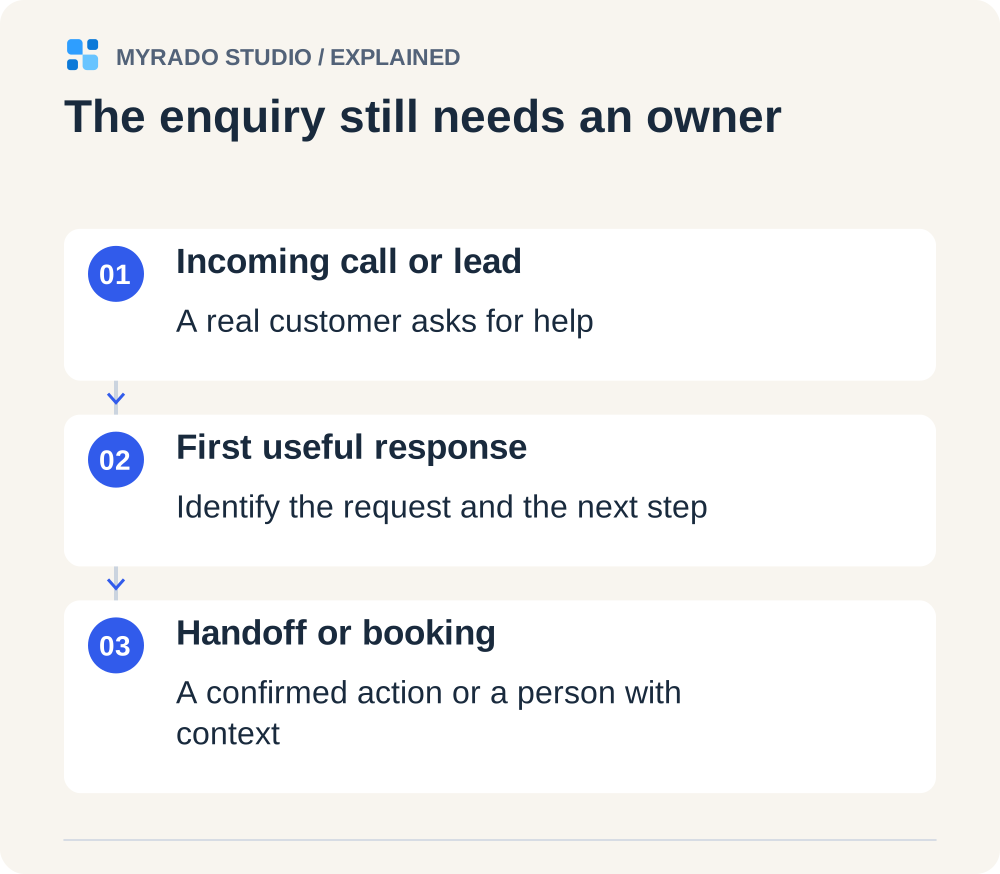
Who is building it, and who has paid
| Industry | Companies | What is public |
|---|---|---|
| Home services (HVAC, plumbing, roofing) | Avoca, Hatch | Avoca valued at $1B (April 2026); Hatch bought by Yelp for about $270M (January 2026) |
| Restaurants | Slang.ai | $36M Series B, 2,000+ locations (February 2026) |
| Dental and medical | Weave, Hello Patient | Weave reported $239M revenue for 2025; Hello Patient raised $22.5M |
| Car dealerships | Toma, Numa | Toma raised $17M from a16z (2025); Numa reports 1,300+ dealerships and tripled revenue (April 2026) |
| Rentals | EliseAI | Valued at $4B (September 2026) |
| Law firms | Clio Duo | Clio valued at $5B (November 2025) |
| Real estate | Structurely, Ylopo | AI assistants for first-touch qualification |
What these have in common is not the technology, which is increasingly commodity, but the choice of a workflow with a high value per customer, a clear definition of success (a booked appointment), and a pain that is about staff and opening hours rather than regulation. That last point is why the idea travels across borders: the problem is the same in Texas and in Kyiv.
The broader market has also consolidated upward. Salesforce completed its roughly $1.2B purchase of Qualified on 1 April 2026, and HubSpot began charging $1 per recommended lead from 14 April 2026. Not every story is a success, which is why vendor claims deserve scrutiny.
What it costs
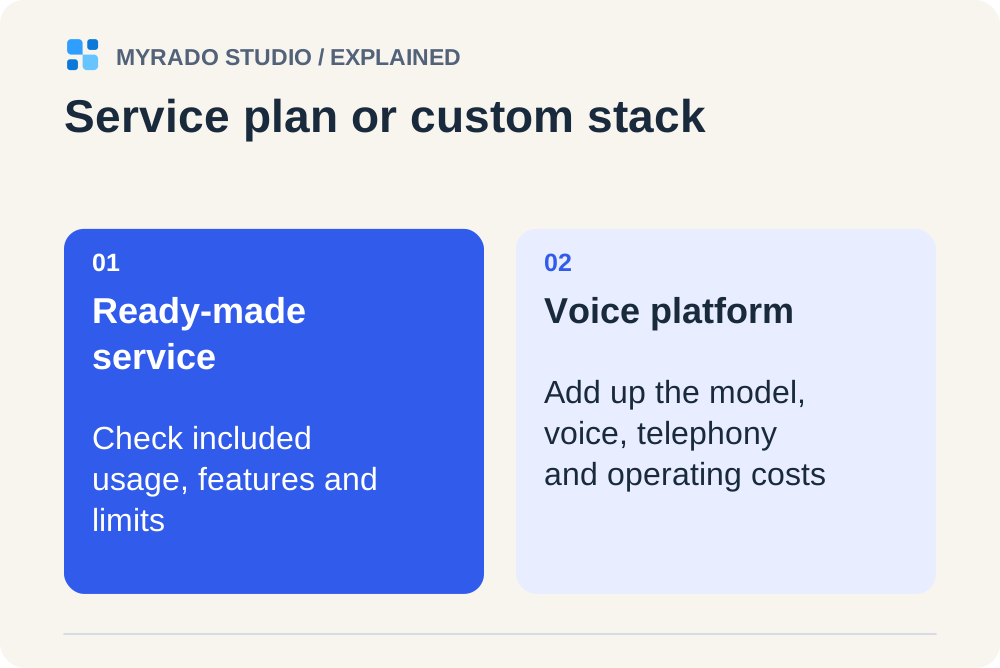
Packaged answering services (monthly list prices, 2026):
| Service | List price |
|---|---|
| Dialzara | $29–349 |
| Rosie | $49–299 |
| Goodcall | $79–249 |
| Smith.ai | $150–500 (sources contradict each other) |
| GoHighLevel with AI Employee | $97–497 plus roughly $97 per sub-account; agencies resell at $197–297 per client |
Voice platforms (per minute): Vapi $0.05 for the platform layer, Retell $0.07–0.12, ElevenLabs Agents $0.08, Synthflow $0.09. Add speech-to-text, the language model, text-to-speech and telephony and the all-in figure is about $0.13–0.31 per minute. For example, 900 minutes a month at that rate is $117–279 before any build or maintenance work.
Text agents: Intercom’s Fin is priced at about $0.99 per resolved conversation and Tidio’s Lyro at roughly $0.58–0.70 per conversation.
If you want a detailed breakdown of building versus running costs, see our guide on how much an AI agent costs.
What the technology still gets wrong
Reviews by users of AI receptionists converge on a few points.

- Expectation gaps. People who bought “never miss a call” are happy; people who expected a human-quality conversation are not.
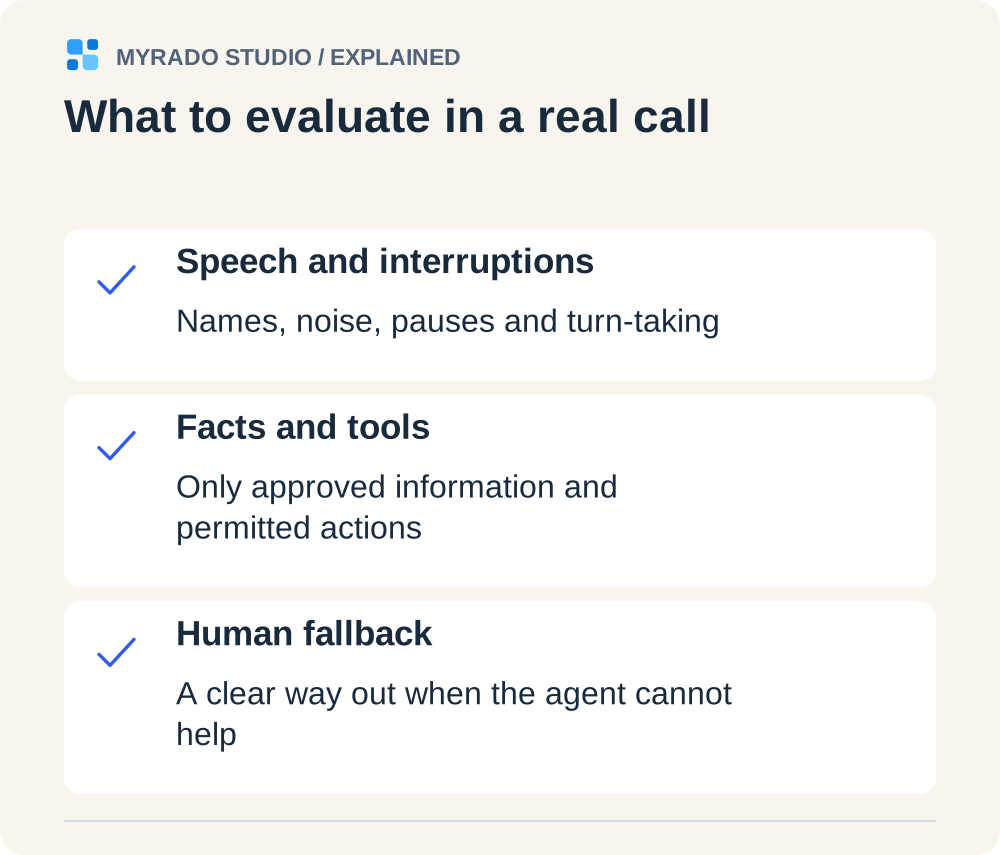
- Confident wrong answers. The worst failure is a plausible but invented price or policy. Keep prices and terms in an approved knowledge base and let the agent say “I will check” when the answer is not there.
- Names, numbers and accents. Speech recognition is the weakest link, especially outside English. Have the agent repeat names, addresses and phone numbers and send written confirmation.
- Disclosure and recording. In the EU, Article 50 of the AI Act has required chatbots and voice agents to make clear they are AI since 2 August 2026. In the US, the FCC treats AI-generated voices as “artificial” for robocall rules. Call recording consent varies by jurisdiction.
- Handover. Sensitive topics — health, legal, money, complaints — should reach a person with a summary of the conversation.
Where the opportunity is outside the US
Western vertical products often do not serve smaller markets. In Ukraine, for instance, a vertical receptionist with a public local-currency price was hard to find in October 2026, partly because Stripe-dependent vendors cannot bill Ukrainian companies and partly because of language and telephony details. Telephony and speech infrastructure are available as APIs; the missing piece is packaging for a specific trade with local integrations. The same pattern holds in other mid-sized markets where the big vendors do not localise.
If you are choosing between building and buying, a sensible order is:
- Audit one week of calls and messages: how many go unanswered, and when?
- Put a dollar value on a booked appointment and multiply.
- Compare with the cost of a person for the same hours.
- Pilot one channel and one use case before expanding.
- Insist on a human handover and on approved answers only.
For industry examples, see the pages on an AI receptionist for home services and for clinics. If you are comparing a scripted bot with an agent that takes actions, AI agent vs chatbot explains the difference, and our team of AI agent developers in Ukraine can scope a pilot.
FAQ
How many business calls go unanswered?
Invoca’s 2026 analysis reports that about 44% of roughly 70 million calls were missed. The founders of Toma, an AI service for car dealerships, found that US dealerships answer only 45% of inbound calls. Treat these as benchmarks from large samples rather than a number for your own business; a one-week audit of your phone log gives the figure that matters.
How fast should a business respond to a new lead?
The often-cited 2011 Harvard Business Review study found that firms reaching a lead within an hour were about seven times more likely to qualify it than firms that waited one more hour. In February 2026 only 3% of teams in one survey replied within five minutes and 31% took longer than a day. An automated first reply can close most of that gap.
How much does an AI receptionist cost?
Packaged services publish list prices of about $29–349 a month (Dialzara), $49–299 (Rosie), $79–249 (Goodcall) and $150–500 (Smith.ai, where sources disagree). Developer platforms charge $0.05–0.12 a minute for the platform layer; with speech recognition, the language model, voice and telephony the all-in figure is roughly $0.13–0.31 a minute.
Do AI receptionists replace human staff?
The better-reviewed deployments do not try to. Reviews from users describe satisfied customers when the goal was never missing a call and unhappy ones when they expected a human-quality conversation. The pattern that works: the agent answers, books and answers routine questions from approved information, and hands anything sensitive or unusual to a person with a summary.
What are the main risks of an AI answering agent?
A confident wrong answer about price or policy is the most damaging failure; the Air Canada chatbot case showed that a company can be held to what its bot promised. Other risks are poor recognition of names and addresses, a missing disclosure that the caller is talking to AI (required in the EU for chatbots and voice agents from 2 August 2026) and recording or consent rules that differ by country.